
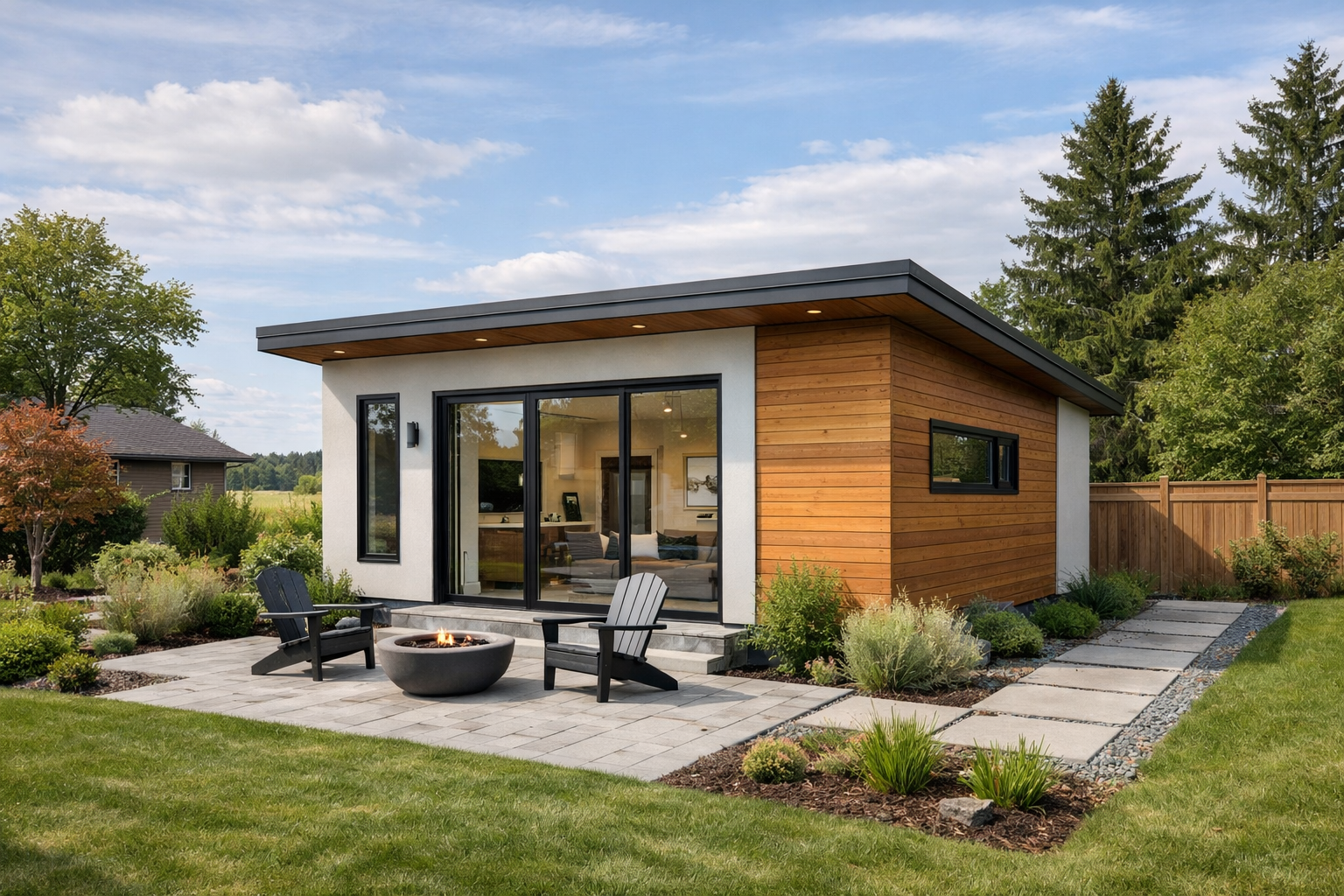
Detached Accessory Dwelling Units are becoming an increasingly popular housing solution across Ontario. Homeowners are exploring ADUs to create rental income, support aging parents, house adult children, or allow families to live closer together while maintaining privacy.
At first glance, the idea can seem straightforward. Build a small home in the backyard and move someone in.
In practice, building a detached ADU is a regulated, multi-stage process. Provincial legislation, municipal bylaws, property conditions, servicing capacity, and construction logistics all influence how a project unfolds.
Understanding the process matters just as much as understanding the concept.
Why Building a Detached ADU Is Not as Simple as It Sounds
Having a large yard, rural zoning, or a country property does not automatically mean a detached ADU can be built.
While the Province of Ontario has introduced legislation, including Bill 17, to encourage additional housing options, municipalities retain control over how those policies are implemented. Each municipality sets its own bylaws governing setbacks, accessory structure coverage, overall lot coverage, building height, placement, and permitted locations on a lot.
The Ontario Building Code adds another layer of requirements related to fire separation, emergency service access, life safety, and building performance.
In addition, many properties must be assessed to determine whether existing electrical, water, or wastewater systems can support an additional dwelling unit. In some cases, upgrades are required before a detached ADU can proceed.
This is why early feasibility and proper guidance are essential.
Understanding the ADU Build Process in Ontario
Building a detached ADU is best understood as a series of coordinated stages rather than a single construction event. Each phase builds on the previous one, and progress depends on approvals, reviews, and conditions that vary by property and municipality.
Initial Feasibility and Property Review
The process begins with a review of zoning bylaws, lot dimensions, setbacks, coverage limits, access requirements, and any conservation or environmental considerations that may apply.
This stage helps determine whether a detached ADU is viable on a specific property before design work begins. Early feasibility review reduces the risk of investing in plans that cannot be approved.
Zoning Confirmation and Municipal Coordination
Once feasibility appears positive, zoning requirements are confirmed through municipal planning departments. This step may involve clarification requests, supporting documentation, or additional review depending on the municipality.
Municipal interpretation and review timelines can vary, and requirements are not always uniform between jurisdictions.
Design, Engineering, and Servicing Review
With zoning direction established, detailed design and engineering work begins. This includes architectural drawings, structural engineering, energy efficiency considerations, and servicing layouts.
Electrical capacity, water supply, and wastewater systems are assessed to determine whether upgrades are required. Identifying servicing limitations early helps avoid disruptions later in the process.
Building Permit Review
Permit applications are reviewed for compliance with municipal bylaws and the Ontario Building Code. This process often includes multiple review stages and may require revisions or additional information.
Permit timelines depend on municipal workload, completeness of submissions, and site complexity.
Construction Material Planning and Availability
Construction sequencing is influenced by material availability and delivery schedules. Certain components, such as windows, mechanical systems, insulation assemblies, and exterior finishes, may be subject to manufacturing or supplier lead times.
Material planning occurs alongside permitting and design to support informed scheduling, but availability remains subject to market conditions beyond the builder’s control.
Construction, Inspections, and Completion
Construction includes site preparation, foundations, structural assembly, mechanical systems, interior finishes, and exterior work. Municipal inspections occur at multiple stages and must be scheduled in accordance with local requirements.
Weather conditions, inspection availability, site access, and third-party coordination can all affect the pace of construction.
Final inspections confirm compliance with approved plans and building code requirements before occupancy is permitted.
From Idea to Occupancy. What Homeowners Should Expect
Rather than following a fixed schedule, detached ADU projects progress through a series of dependent steps. Some projects move more smoothly than others based on property conditions, municipal responsiveness, servicing requirements, and external factors.
For most homeowners, the journey from initial feasibility review to final occupancy is measured in months rather than weeks.
Clear planning at the beginning is the most effective way to reduce uncertainty and avoid preventable delays.
Why Experience Matters When Building a Detached ADU
Detached ADUs require more than construction expertise. They demand familiarity with zoning bylaws, building code requirements, servicing coordination, and municipal processes.
Smart Home Designs Niagara approaches each project by reviewing zoning, infrastructure, material considerations, and sequencing early. This allows potential challenges to be identified in advance and addressed proactively.
The result is clearer expectations and a smoother process from concept through completion.
Considering a Detached ADU?
Because zoning rules, servicing capacity, and municipal requirements vary by location, the first step is understanding what may be possible on a specific property.
Smart Home Designs Niagara offers discovery conversations designed to review high level zoning considerations, discuss the ADU process, and identify potential constraints before formal design work begins.
Book a Discovery Call to start the conversation and determine appropriate next steps based on your property and municipality.
The information provided is for general educational purposes only and is not intended as a guarantee of approvals, timelines, costs, or outcomes. All Accessory Dwelling Unit projects are subject to municipal bylaws, provincial regulations, site conditions, third-party approvals, material availability, inspection scheduling, and other factors beyond the control of the builder. Actual requirements and timelines vary by property and municipality. Site-specific guidance should be obtained before making decisions.